3.2.2 Equilibrium-based shoreline evolution model (EBSEM)
The development of the EBSEM is conceptually grounded in the balance between constructive and destructive forces acting on a beach, allowing for the estimation of shoreline position at any given time. EBSEMs are desgined for environments where the net sediment transport fluctuates around a theoretical equilibrium as influenced by storms, seasonal shifts, or interannual factors. More specifically, these models are functions (Fig. 3-3-1) of the wave conditions and beach morphology (\(K'\)) as they relate to the disequilibrium between current conditions and a theoretical equilibrium (\(ΔX'\)). These models are especially applicable in macrotidal environments and those that experience seasonal variations in beach profile and shoreline position.
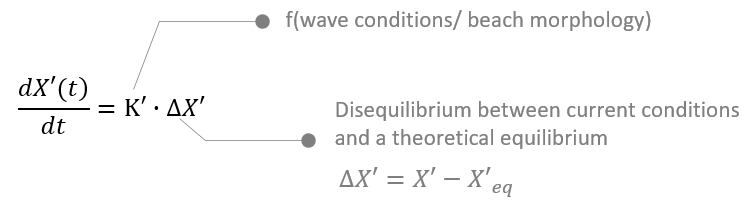 Fig. 3-2-2. The general formula and components of EBSEMs.
The approach taken by these models typically classifies sediment transport directionally, falling into the categories of cross-shore or rotational (longshore) models. Cross-shore models take into account the seaward and landward movement of the shoreline as a result of wave forcings acting normal to the beach. On the other hand, longshore models represent the rotation of the beach around a pivotal point as sediment is transported across the beach by currents acting parallel to the beach.
3.2.2.1 Cross-shore
Cross-shore EBSEMs account for erosion and accretion caused by destructive and constructive forces respectively acting perpendicularly to the shoreline, shown in Fig. 3-3-1-1. For this reason, they can be especially useful for viewing the affects of seasonal variation of wave energy on the beach.
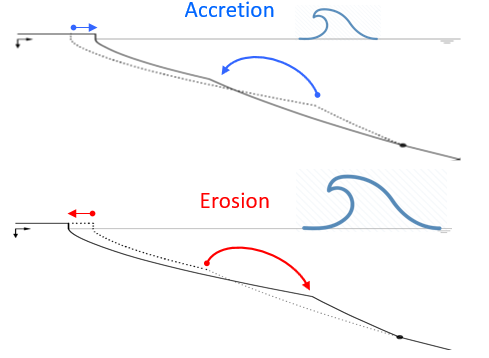 Fig. 3-2-2-1. Representation of sediment migration as a result of cross-shore wave forcing.
In particular, several models in the literature focus solely on cross-shore displacement, including works by Miller and Dean (2004), Yates et al. (2009), Davidson et al. (2013), Jara et al. (2015) and Jaramillo et al. (2020)
The following models are the EBSEM for cross-shore sediment transport included in IH-SET. Each model has been developed to capture equilibrium-based shoreline evolution specifically for cross-shore dynamics.
3.2.2.2. Rotation
Alongside cross-shore EBSEM models, many studies have developed models that simulate shoreline evolution driven by beach rotation. These models aim to simulate the gradual rotation of beaches influenced by shifts in wave direction that cause variation in the longshore migration of sediment, shown in Fig. 3-3-2-1.
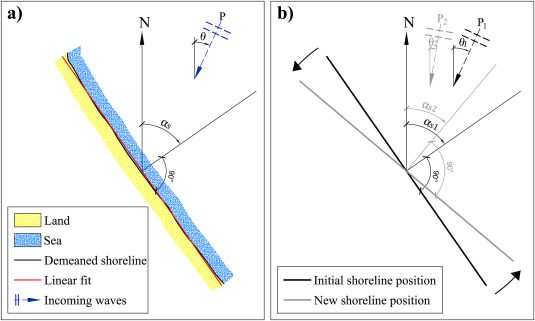
Fig. 3-2-2-1. Representation of shoreline rotation resulting from the longshore migration of sediment.
Some of these simplified models focus on changes in shoreline orientation and are especially applicable to embayed beaches (e.g., Turki et al. (2013) and Jaramillo et al. (2021a)).
The following models are the EBSEM for beach rotation included in IH-SET. Each model has been developed to capture equilibrium-based shoreline evolution specifically for rotational dynamics.
